Vanity Ethereum Addresses: How They’re Generated—and Why I’m Skeptical
Vanity Ethereum addresses: the idea
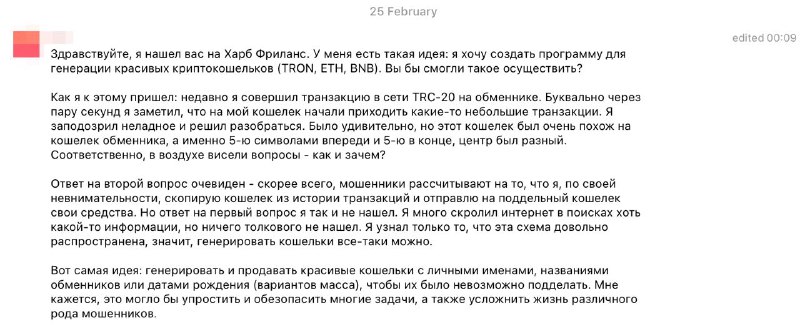
Recently, a client approached us with a business idea: sell “beautiful” crypto addresses. The logic is straightforward—people might pay for an address that starts with something recognizable: a name, a company brand, a birth date, or a satisfying numeric pattern.
In Ethereum (and other EVM chains), addresses look like this:
0x0007A974fA7D03aD178Dd9138559834b0CaB8The first limitation: it’s hex, not an alphabet
There’s an immediate practical constraint that many people underestimate: an Ethereum address is represented in hexadecimal (base-16). That means you’re not picking from the full alphabet—letters are limited to:
- A, B, C, D, E, F
So yes, you can hunt for patterns, but you can’t freely spell most names or brands. The “vanity” space is narrower than it looks at first glance.
How vanity addresses are actually generated
Creating a vanity address is usually just brute force:
- Generate a private key.
- Derive the public key and then the address.
- Check whether the resulting address matches the desired prefix/pattern.
- If not, repeat—potentially millions or billions of times.
This can take a very long time. The runtime depends on how specific the pattern is and how much compute you throw at it (CPU/GPU, parallelization, etc.). If we go deep into the cryptographic pipeline, there are plenty of algorithms and abbreviations involved—but that’s a separate technical write-up.
Keyspace isn’t infinite (but it’s effectively unsearchable)
People sometimes say the number of private keys is “infinite.” It isn’t. For Ethereum, the private key space is:
2^256 = 115792089237316195423570985008687907853269984665640564039457584007913129639936That number is so large that brute forcing a specific user’s private key remains unrealistic—but brute forcing addresses with a chosen pattern is exactly what vanity generation does, just in a targeted way.
Why I’m skeptical: it clashes with core security principles
Here’s my main concern with the “sell vanity addresses” model: it can easily violate the foundational security assumptions of blockchain wallets.
For a buyer to receive a vanity address, someone must generate the private key that controls it. If a third party generated that private key, the buyer is trusting that:
- the key wasn’t stored, copied, or logged,
- the infrastructure used for generation wasn’t compromised,
- the seller won’t use the key in the future.
In other words, the private key is effectively compromised by the very existence of this service. Even if the seller is honest, the risk model is fundamentally worse than a wallet generated locally by the user on trusted hardware.
My takeaway
Vanity addresses are a fun technical challenge and can be useful in narrow cases (for example, when the user generates them themselves). But as a product where a third party generates and sells keys to end users, I consider it misaligned with how we’re supposed to think about private key custody.
I’m curious what you think: would you ever trust a purchased vanity address for anything beyond a disposable wallet?

Alex Meleshko
Entrepreneur, CEO, and builder at the intersection of blockchain, AI, and startups.